

Let's Protect Your Wallet from Trump’s Tantrums
How to Navigate Trump’s Economic Outbursts

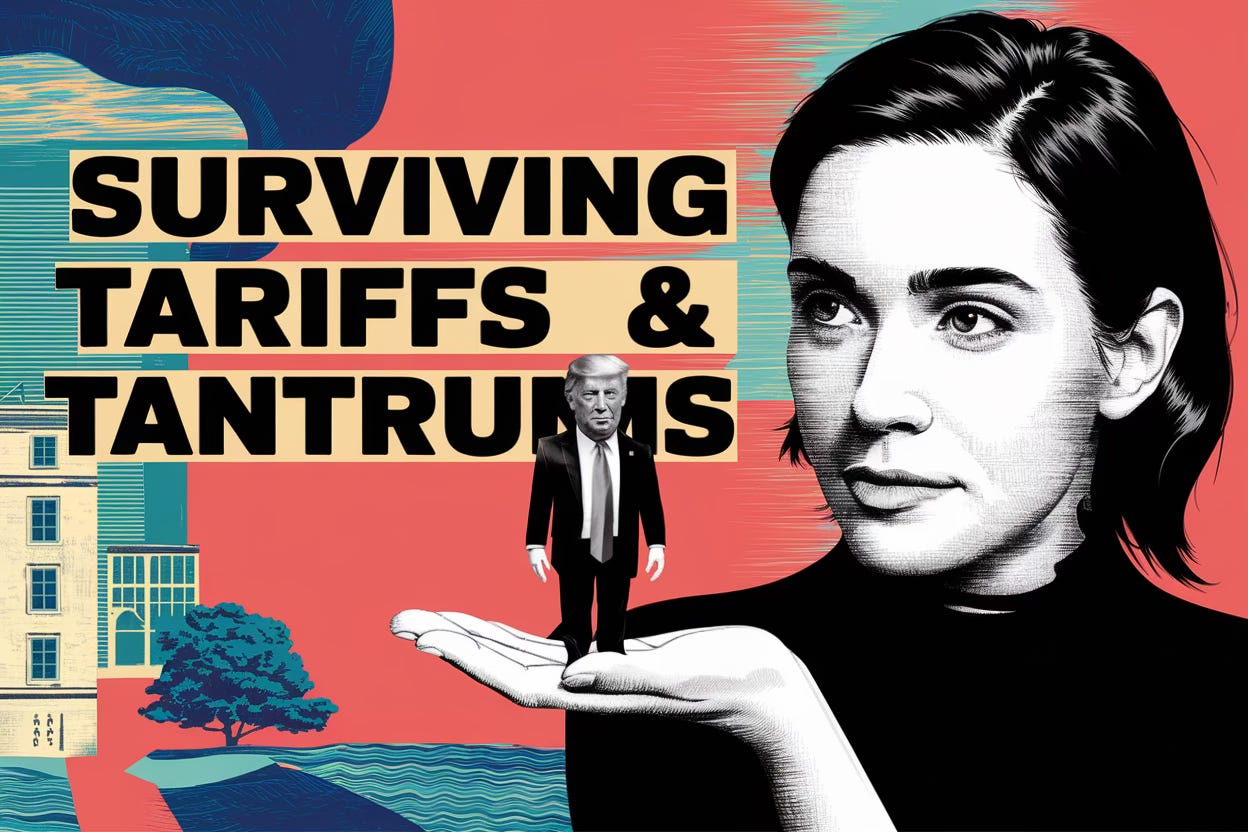
Picture this: a toddler in a grocery store, red-faced and howling because the wrong cereal box dared to exist.
Now replace the cereal with semiconductors, the toddler with a world leader, and the aisle with global markets.
Congratulations—you’ve just visualized a tariff spat.
This chapter isn’t about soothing tantrums (good luck with that).
Let’s dissect the chaos, sip our metaphorical lattes, and arm you with strategies to thrive. By the end, you’ll grasp:
The real economic impact of tariffs (spoiler: it’s not 1933).
Why the U.S. economy isn’t collapsing (despite the hysterical headlines).
How to profit like a fox while others panic.
Remember the 1930s? History Rhymes, It Doesn’t Repeat
In 1930, the U.S. passed the Smoot-Hawley Tariff Act, hiking duties on over 20,000 imported goods.
The goal? — Protect American jobs.
The result? — A global game of economic chicken.
Countries retaliated, trade volumes plummeted 65%, and the Great Depression deepened. It was like setting your couch on fire to stay warm—effective for three seconds, catastrophic thereafter.
Today, we’re nowhere near that extreme—though the choreography looks suspiciously familiar.
Fast-Forward to 2018
Enter Trump’s tariffs on Chinese steel.
Beijing retaliated with levies on soybeans, hitting U.S. farmers.
Cue headlines: “TRADE WAR LOOMS!”
But here’s the twist: Modern economies are junkies hooked on globalization.
Apple won’t abandon Shenzhen factories. Germany won’t stop selling BMWs to Ohio.
The system is too codependent for a 1930s rerun—but that won’t stop politicians from flirting with disaster for applause.
My read
Tariffs are political Viagra: short-term swagger, long-term regret.
But unlike the 1930s, today’s leaders have Twitter and short attention spans.
Politicians love the short-term shock factor of announcing tariffs. But global powers hate paying someone else’s bill. They retaliate, ramping up uncertainty, and uncertainty is basically a Red Bull for market volatility.
Many times, we see leaders backtrack once they realize they’ve unleashed an economic boomerang.
Despite that gloom, let me be clear: America’s finances aren’t on the verge of a meteor strike.
Our Fed is still relatively friendly, interest rates aren’t so high they choke off credit, and consumers are still out there shopping.
That’s the short version of why I consider this mess a sharp correction, not a permanent winter.
If the Sky Isn’t Falling, Why Do People Panic?
Because fear is easier to sell than rationality.
We scroll doom-laden headlines about trade wars, picturing a tumble into some Great Depression sequel.
In reality, the world trades with each other like an intricate spiderweb—no single country wants to burn the entire net.
When tariff threats ratchet up, you might see:
Manufacturing stocks dip, especially those relying on cheap imported parts.
Export-heavy sectors face margin pressures if their foreign customers slap on retaliation fees.
But many big U.S. corporations still boast robust profits. The labor market remains decent.
And interest rates have been drifting lower from their peaks, making borrowing a bit friendlier.
Put those together, and you’ve got a sense that the underlying economy can take a few punches—just maybe not an endless beating.
Let’s get specific. Here’s how to safeguard your portfolio:
Since the chaos isn’t forever, it presents a golden window. Tariffs cause temporary market dips—which is Wall Street code for “everything’s on sale.”
Yes, I’m telling you that your clueless uncle who panic-sells during every political kerfuffle is unknowingly subsidizing your future returns. Thank him later.
1. Scoop up cheap index funds (not risky stocks).
You’re not looking for a hero’s gamble. You want to quietly buy Vanguard’s Total Stock Market ETF (VTI) and similar broad-based index funds during any dramatic market dip. They’re boring, predictable, and brilliant. Tariff-induced dips? They’re your Black Friday shopping spree.
2. Consider defensive ETFs and Treasury Bonds (if you’re nervous).
If you’re less adventurous (no shame), buy a bit of a bond ETF like Vanguard Total Bond ETF (BND) as a cushion. Bonds won’t win you the lottery—but they’ll help you sleep at night while the world pretends to end outside.
3. Keep your eye on exporters and importers.
Companies heavily reliant on imports (think retail and tech hardware) might get temporarily bruised by tariffs. Meanwhile, domestic-centric industries (utilities, healthcare, consumer staples) can feel safer. But remember—once tariffs fade, today’s “victims” often become tomorrow’s biggest winners. Buy the dips; ride the recovery.
4. Do absolutely nothing impulsive.
Panic-selling because politicians are playing economic chicken is exactly how investors lose long-term wealth. Sit tight, do some yoga breathing, mute the news notifications, and trust decades of market history.
Tailored for Women: Harnessing This Market Sideshow
Why does this matter especially for us?
Career Armor:
Rule 1: If you work in manufacturing, upskill now. Learn automation software. Tariffs kill low-skill jobs; they create demand for robot whisperers.
Rule 2: Build a 12-month emergency fund. Not 3. Not 6. Twelve. Trade wars breed layoffs; outlast them.
Wealth Preservation: Municipal bonds (“munis”) are the crockpot of investing—slow, steady, and tax-free. Even if tariffs ignite inflation, munis’ tax-exempt status shields you.
Example: A 4% muni yield equates to a 6.15% taxable yield if you’re in the 35% bracket.
Bonus: Munis fund schools and hospitals. Profit and karma.
Wealth Accumulation: Example: Tariffs slam renewable energy stocks. You research and find NextEra Energy (NEE) has locked in Chinese solar panel imports at pre-tariff prices. Buy. Wait. Outpace the S&P 500 by 15%.
Ultimately, I see these tariff threats as political power plays. They might drag on, but they rarely lock down the economy forever.
Politicians—like toddlers—tire of their own tantrums.
But if you’re smart enough not to freak out—is that you’re essentially gaming Wall Street’s own drama.
Think of it like this: Wall Street banks billions on emotional investors who panic, trade often, and bleed money in fees and taxes.
Being calm, deliberate, and even slightly amused by the chaos is your superpower.
Thanks for reading!
Jane